An EPK (electronic press kit) is a musician’s press kit in digital form: one link where a journalist, a promoter, a festival programmer or a label can find your bio, music, photos, video, press quotes and contacts. If you are wondering whether you need an EPK for your music, the short answer is yes. It is usually the first thing people ask for when you write to a magazine, a venue or an agency.
This guide explains what goes into an EPK, how it differs from a one-sheet and a press release, and how to make an EPK step by step. There is a checklist you can copy, a section on using AI for a first draft, and the mistakes we see most often at Monart when we prepare music PR campaigns for jazz and independent artists in Europe and the Americas.
What is an EPK and what is it for?
Apple Music for Artists puts it well: an EPK is your “professional resume and business card”, gathered in one place so that managers, booking agents, venues, promoters and journalists can look at your work quickly.
In practice it does three jobs:
- It saves the reader time. A music journalist gets dozens of pitches a day. If everything they need is behind one link, they are far more likely to write about you.
- It keeps your image consistent. Same photo, same bio, same spelling of the band name everywhere, instead of three old versions floating around.
- It opens concrete doors: reviews and interviews, radio play, festival and club bookings, playlists, and conversations with labels, booking agents and managers.
Digital first, print on request
The way we see it, an EPK is digital first: a web page (a section of your website or a dedicated page) that you share as a link and update whenever something changes. A new review comes out, a tour is announced, you have new photos: you update the page and the link you sent last month is still current.
You can also keep a print or PDF version for whoever asks for one, such as a festival committee, a cultural institution or a funding body. It carries the same content. But the link is the reference, and the PDF is a snapshot of it.
A list of content, not a fixed design
An EPK is not a template with a mandatory order. It is a list of content. You can lay it out as one long page, in two columns, in tabs or in separate sections, whatever tells your project best. A solo pianist and a twelve-piece Afrobeat band will not need the same layout, but both need the same building blocks.
What to include in an EPK: the checklist
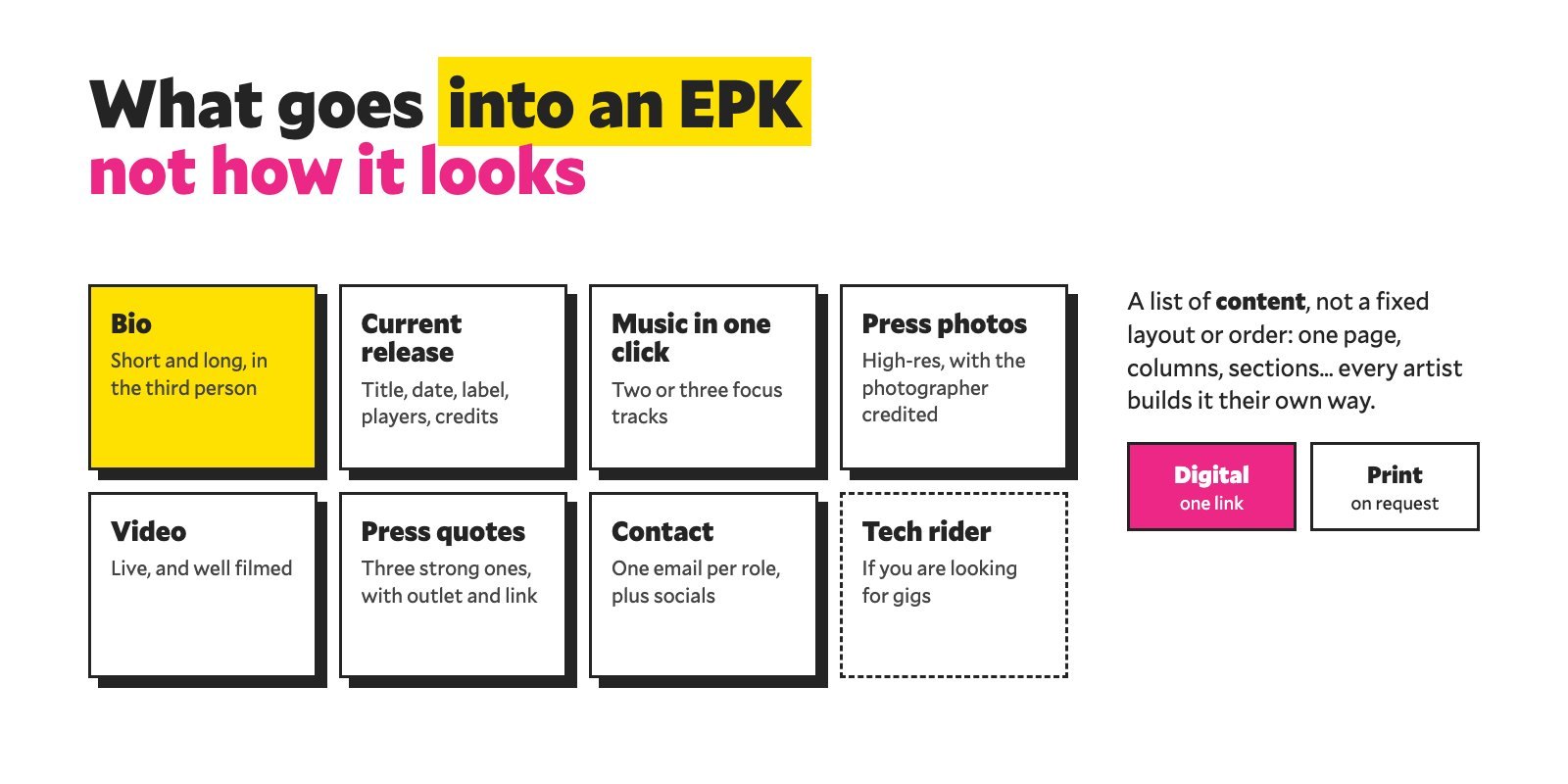
Copy this list and tick it off. The order is a suggestion, not a rule.
1. Bio (short and long)
Written in the third person, so a journalist can paste it as is. Apple’s EPK page makes the same point. Have a short version of around 60 to 100 words and a long one of 300 to 500 words. If you work across countries, have it in English and in the language of the other markets you target. We wrote a separate guide on how to write an artist bio, with examples.
2. Your current release
Title, release date, label (or self-released), tracklist, line-up and main credits. On a jazz record the sidemen matter as much as the leader: name them and their instruments.
3. Music you can hear in one click
Links to Spotify, Apple Music and Bandcamp, or a private streaming link for press before release day. Highlight two or three tracks. Nobody listens to a full album on first contact.
4. High-resolution press photos
Three to six professional photos, landscape and portrait, with the photographer’s credit in the file name or next to each image. Add the cover artwork in high resolution.
5. Video
A live video or a music video. For festival and club programmers, a well-filmed live clip often weighs more than any paragraph.
6. Press quotes and highlights
Short quotes from reviews (outlet name plus link), awards, notable festivals and tours. Three strong quotes beat twenty minor mentions.
7. Contact details
Management, booking, press and socials, with one email per role. If you have no team yet, a professional email and a phone number are fine.
8. Optional: tech rider and show format
If you are looking for gigs, add the technical rider and the show format (duo, trio, set length). Promoters appreciate not having to ask.
EPK vs one-sheet vs press release
These terms get mixed up. Here is how we use them:
| Format | What it is | When to use it |
|---|---|---|
| EPK / press kit | Your full artist page: bio, music, photos, video, press, contact. | Always. It is your base. |
| One-sheet | A single page about one release: cover, short text, tracklist, date, links. | For press, distributors and playlist curators just before a release. |
| Press release | A news text about one event: the album is out, a tour is announced. | For the news itself, with the EPK linked at the end. |
| Media kit | A document influencers and outlets use to sell advertising (audience, rates). | Not for musicians looking for coverage. |
If you are preparing a release, the ideal set is all three of the first ones: the EPK (permanent), a one-sheet for the record and a press release for the launch. For timing, see our guide to building a music marketing plan.
How to make an EPK, step by step
- Decide who it is for. A jazz critic in London, a festival in France and a college radio host in the US do not read the same way. Your audience shapes the language, the tone and what you put first.
- Write the short bio first. If you cannot explain your project in 80 words, the rest of the EPK will struggle.
- Gather your visuals. Credited photos, the cover in high resolution, one good live video. If you have no recent professional photos, that is where to spend first.
- Choose where it lives. A page on your own website is the most practical option: easy to update, easy to share, and it can be found in search. EPK builders and website platforms offer templates if you have no site yet; your own site gives you more control.
- Put the most important things where they are seen first: who you are, what you are releasing, a play button, then photos and video, press, contact.
- Make language versions if you work internationally. An English-only EPK may be enough for the UK and the US, but if you are pitching festivals in France or Spain, a version in their language shows you have done your homework.
- Check it on a phone. Most people open your email on their phone. If the page is slow or the photos weigh 15 MB each, you have lost them.
- Prepare the PDF last. Export or design a printable version from the same content, for whoever asks.
- Update it with every release. New quotes, new dates, new photos. A stale EPK looks worse than none.
About “music EPK templates”
Templates are useful to see what other artists include, and a good starting point if you have nothing. Two things to keep in mind. First, a template is a layout, and your project may need a different one: a classical ensemble may need repertoire lists, a DJ may need mixes and venue logos. Second, if a template pushes you towards a PDF only, remember that the PDF goes out of date the day you send it. Use the checklist above as your template, and pick the layout that fits.
How to use AI for a first draft (and what to fix yourself)
Many artists already use ChatGPT, Claude, Gemini, Mistral or another AI assistant to draft the text parts of their EPK. That can help with the blank page, as long as every fact comes from you. What works for us is not asking the AI to write straight away, but asking it to interview you first, the way a journalist would:
“You are a music journalist preparing my electronic press kit. Before writing anything, interview me. Ask me one question at a time about my project, my background, my music, my current release, the musicians involved and what makes this record different. Wait for each answer before asking the next question. When you have enough, write an 80-word bio and a 300-word bio in the third person, a one-paragraph description of the release, and a list of what is still missing from my EPK. Use only what I tell you. Do not invent awards, numbers, quotes or collaborations.”
You can answer in writing or out loud. Most of these tools have a voice mode, or you can record your answers as a voice memo, transcribe it and paste the text in. Talking usually brings out better stories and your own way of describing the music.
What we always fix by hand afterwards:
- Facts. AI tends to fill gaps. Check every name, date, venue and spelling.
- Stock phrases like “a unique sonic journey” or “pushing the boundaries of genre”. Replace them with one concrete detail about your music.
- Press quotes. Only real quotes from real outlets, with links. Never let the AI paraphrase or “improve” a review.
- Your voice. Read it aloud. If it does not sound like something your project would say, rewrite it.
That said, if you can afford it, nothing beats someone who writes for a living: a music copywriter, a press agency, or a music journalist who takes commissions (who, for ethical reasons, usually won’t review that same record afterwards). AI gets you to that conversation with your ideas in order, or gives you a decent draft when the budget isn’t there.
Common EPK mistakes we see
- A first-person bio, or a bio that is too long. The journalist cannot paste it and has no time to rewrite it.
- Uncredited or low-resolution photos. An outlet cannot publish a photo without knowing who took it.
- Broken links or expired private links. Click every link before each send.
- Out-of-date information: tour dates from two years ago, members who left the band.
- Duplicate streaming profiles. If your project appears under two artist profiles, the journalist does not know which one is real. Merge them before you pitch.
- Sending the EPK as a heavy attachment. Send a link to a page or a well-organised folder.
- Leading with numbers instead of music. Follower counts do not replace a play button.
When does it make sense to have an agency build your EPK?
If you are preparing a record with a press campaign, the EPK is part of the work: what the journalist opens has to match the level of the outlet you are writing to. At Monart we build EPKs as part of our music PR and release campaigns, alongside the press release and the media outreach, in English, French and Spanish when the campaign needs it. You can see some of the projects we have worked on, such as Raíces by Ben García & Lucas Martínez or Luca de Dios, on our Our Work page.
Want a second pair of eyes on your EPK? Book a one-hour video call with Gustavo Mezo to go through your EPK together, with concrete notes on what to change before your next pitch. It costs €80, and the fee is deducted if you then hire Monart for a campaign. Book a consultation
FAQ
What does EPK stand for?
EPK stands for electronic press kit. It is the digital version of the old paper press kit that artists used to post to magazines and radio stations.
What should an EPK include?
A short and a long bio in the third person, your current release, links to your music, high-resolution press photos with credits, a video, press quotes and highlights, and contact details. If you are looking for gigs, add your tech rider and show format.
Should my EPK be a website or a PDF?
Digital first: a web page you share as a link and update whenever something changes. Keep a PDF or print version with the same content for anyone who asks, such as a festival committee or an institution.
Is there a standard EPK layout or template?
No. An EPK is a list of content, not a fixed design. One page, columns or separate sections all work, as long as the essentials are easy to find and it reads well on a phone.
How long should an EPK be?
As long as it needs to be to show the essentials, and no longer. Someone should understand who you are and hear your music within a minute or two of opening it.
How often should I update my EPK?
With every release, tour or important review. Because it is a link, updating it means everyone you have sent it to sees the current version.
Sources
Apple Music for Artists, Why an Electronic Press Kit matters, read on 24 October 2026. Search data: SE Ranking, October 2026.
By Gustavo Mezo, founder of Monart, a music marketing agency based in Paris.