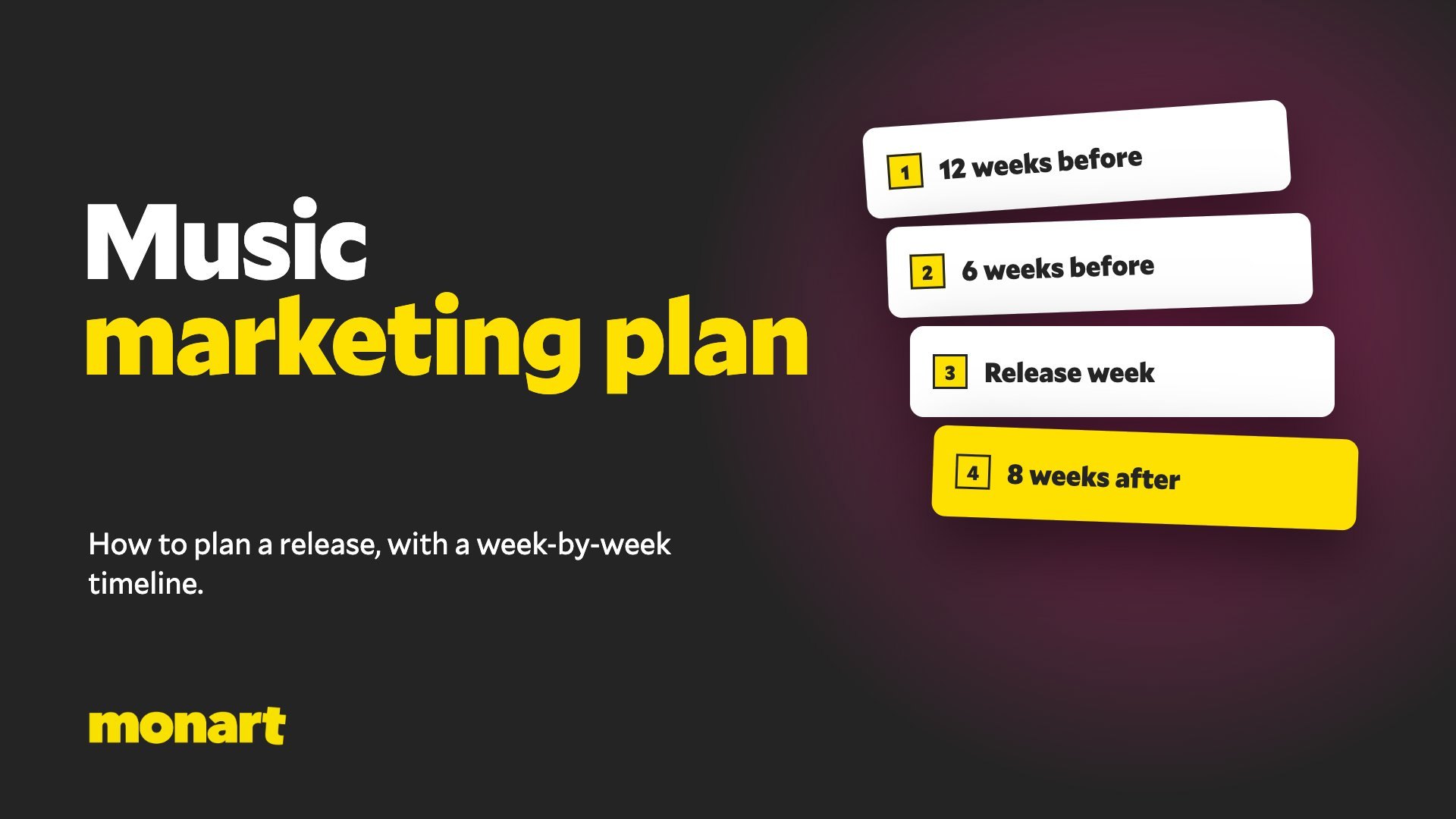
A music marketing plan is the calendar and the reasoning behind your release: who you want to reach, what you will send them, through which channels, with what budget and in what order. Without one, most artists do everything in the last two weeks, post the link on release day and wonder why nothing happened. With one, the same effort lands at the right moment.
This guide covers how we build a music marketing strategy for a release at Monart: the questions to answer first, the pieces you need, and a week-by-week timeline from three months before release day to two months after. It works for a single, an EP or an album, in jazz, classical, world, folk, electronic or pop & rock. Adjust the weights, not the logic.
Music marketing strategy: why a release needs a plan
Most of the work that makes a release visible happens before it comes out. Journalists plan their reviews weeks ahead. Radio producers build their shows in advance. Festival programmers book months ahead. Spotify asks for unreleased music to be delivered at least seven days before release if you want to pitch it to its editors. If you start promoting on release day, many of those doors are already closed for this record.
That is why our campaigns usually start two to three months before release and run one to two months after it, longer for an album with several singles. The weeks after release matter as much as the ones before: reviews arrive late, radio keeps playing, and ads work better once there is music, video and press to show.
Step 1: Decide what success means for this release
Before you plan anything, write down two or three goals. Be specific and honest:
- More listeners in one or two countries where you want to tour.
- Reviews or interviews in specialist press in a given market.
- Concert bookings for the next season.
- A bigger mailing list or more followers who actually come to your shows.
- Material (quotes, videos, photos) you can use for the next two years.
Goals decide everything else. A jazz trio that wants to tour Germany next year needs German press and promoters, not a viral TikTok in Brazil. Be wary of anyone who promises numbers: nobody can guarantee streams or press coverage. Spotify is clear that any service that “guarantees streams, Spotify followers, or playlist placement in exchange for money is not legitimate and should be avoided”.
Step 2: Know who you are talking to
List your audiences, in order of priority:
- Listeners: where they are (country, city), what else they listen to, which platforms they use, which language they speak.
- Gatekeepers: journalists, radio hosts, playlist curators, bloggers, podcasters in your genre and your target countries.
- Industry: promoters, festivals, venues, booking agents, labels.
- Your own community: fans, mailing list, students, past audiences, the musicians you have played with.
Each group needs different material and a different message. Press needs a press release and an EPK. Listeners need short videos and a link. Promoters need a live video and dates.
Step 3: Get your assets ready
Most delays in a campaign come from missing material. Before the timeline starts, list what you need and who is making it:
- Final masters and release date, delivered to your distributor in good time.
- Cover artwork and variations for social media and ads.
- Press photos (landscape and portrait, credited).
- Your bio in three lengths; see our guide on how to write an artist bio.
- An EPK page and a press release for the release.
- Video: at least one music video or live video, plus short vertical clips for social media.
- A smart link or release page that collects all platforms.
- Up-to-date profiles: streaming platforms, website, social media.
Step 4: Set the budget, and keep ad spend separate
Split your budget in two:
- Work: design, video, PR, campaign management, your own time.
- Ad spend: the money that goes to Meta, Google or YouTube.
At Monart the ad spend is always separate from our fee, and we prefer to run ads inside the artist’s own ad accounts. That way the audiences, the data and the pixel history stay with you after the campaign, and the next release starts from there instead of from zero. If you have no ad account yet, setting one up is part of the preparation. Our music ad campaigns page explains how we work.
Small budgets are fine. Spread them over several weeks rather than spending everything on release day.
Step 5: The week-by-week release timeline
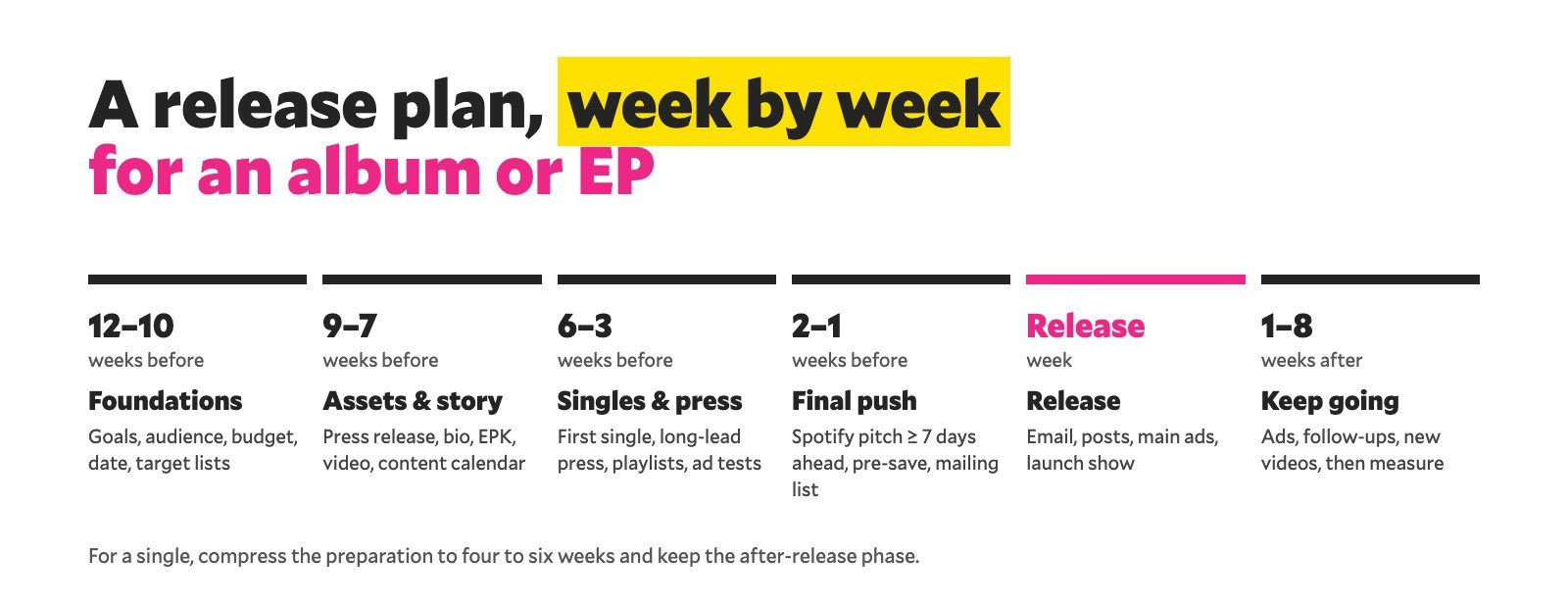
This is the timeline we use as a starting point for an album or EP. For a single, compress the preparation to four to six weeks and keep the after-release phase.
12 to 10 weeks before release: foundations
- Set goals, audiences and budget (steps 1 to 4).
- Confirm the release date and deliver to your distributor as early as you can.
- Book photo and video shoots if they are not done.
- Decide which track(s) lead the campaign.
- Build your target lists: press, radio, curators, promoters, by country.
9 to 7 weeks before: assets and story
- Write the press release, the bio and the EPK.
- Finish the music video and cut short vertical clips.
- Plan the content calendar for social media: what you post each week, in which format.
- Set up or check your ad accounts, pixel and smart link.
6 to 5 weeks before: first single and press preview
- Release the first single (or the focus track) if you have one.
- Send the press release with a private listening link to long-lead press: magazines, specialist outlets, radio shows that plan ahead.
- Start sharing the story on social media: rehearsal clips, studio moments, the artwork.
4 to 3 weeks before: momentum
- Second single or video premiere, if planned.
- Follow up once with press, politely and without deadlines.
- Pitch to playlist curators and radio.
- Announce release concerts or a launch show.
- Start small ad tests with the video clips to see which ones work.
2 to 1 weeks before: final push
- Pitch the release to Spotify’s editors through Spotify for Artists. Spotify asks you to deliver at least seven days before release, and pitching on time also places the song in your followers’ Release Radar. One song at a time, and no placement is guaranteed.
- Pre-save campaign and mailing list announcement.
- Prepare the posts, stories and email for release day.
Release week
- Release day: email your list, post across platforms, update your website and EPK with the new links.
- Launch the main ad campaign with the clips that performed best in testing.
- Share every review, interview and playlist add as it comes.
- Play live if you can: a launch concert gives press and fans a reason to show up.
1 to 4 weeks after: keep it going
- Keep ads running, adjust weekly based on what works.
- Second follow-up with press who showed interest; send reviews to promoters.
- Release a live video, a behind-the-scenes clip or an acoustic version.
- Pitch the next single to radio.
5 to 8 weeks after: extend and measure
- Another single or video from the record, if it is an album.
- Use press quotes in your EPK, ads and booking pitches.
- Write a short report: what worked, what didn’t, which countries responded, what you learned for next time.
Step 6: Measure what matters
Look at a few numbers that connect to your goals, not everything:
- Listeners and saves in the countries you targeted, and how many come back.
- Followers and mailing list sign-ups, which you will reach again next time.
- Press: reviews, interviews, radio plays, and the quotes you can reuse.
- Concerts: enquiries and bookings that came from the campaign.
One thing we always explain: an ad click is not a stream. Spotify counts a stream when someone plays your song for at least 30 seconds. If the clicks are high and streams low, the problem is usually the first seconds of the track or a gap between what the ad promised and what people hear.
Real examples from our work
We cannot share our clients’ numbers here, but we can share what plans looked like. For León Chiprout, the campaign is built around a series of singles, each with its own content calendar. For Grégory Sallet’s Japan tour, the plan was built backwards from the tour dates, with reels, ads and a poster ready ahead of the concerts. For Raíces by Ben García & Lucas Martínez and for Luca de Dios, press in Europe and Latin America was at the centre. You can read more about these projects on our Our Work page.
How to use AI for a first draft (and what to fix yourself)
ChatGPT, Claude, Gemini, Mistral and other AI assistants can help you turn a pile of ideas into a first plan. The trick is to make the AI interview you first, one question at a time, before it suggests anything:
“You are helping me build a marketing plan for my next release. Before recommending anything, interview me. Ask one question at a time and wait for my answer. Ask about the release (format, date, genre), my goals, where my listeners are, what material I already have, my budget, my team, and what I did last time. When you have enough, draft a week-by-week plan from 12 weeks before release to 8 weeks after, with a list of assets and who prepares each one. Do not promise results, streams or press coverage, and flag anything you are unsure about.”
You can answer in writing or by voice, using the voice mode or a transcribed voice memo. Speaking often brings out details you would skip in writing.
What we always fix by hand afterwards:
- Dates and deadlines. Check your distributor’s delivery times, press deadlines and holidays in your target countries.
- Platform rules. AI is often out of date on how Spotify, Meta or YouTube work. Check every requirement on the official pages.
- Generic tactics. “Go viral on TikTok” is not a plan. Keep only actions that fit your genre and your audience.
- Budget realism. Make sure the plan matches the money and time you actually have.
And if the release really matters, an hour with people who plan campaigns every week, an agency, a publicist or a manager, will save you more than any prompt. AI is a good way to get your thinking in order before that conversation.
When to bring in an agency
If you are releasing a record and want the plan, the press, the content and the ads to work together, that is what our music marketing campaigns are for. We work from Paris with artists in jazz, classical, world, folk, electronic and pop & rock, with our strongest network in European jazz and a bridge between Europe and the Americas. Press can be part of it when it makes sense.
Want a second opinion on your release plan? Book a one-hour video call with Gustavo Mezo to go through your plan, timeline and budget together. It costs €80, and the fee is deducted if you then hire Monart for a campaign. Book a consultation
FAQ
What is a music marketing plan?
It is the calendar and the reasoning behind a release: goals, audiences, assets, budget, channels and a week-by-week timeline of what happens before and after release day.
How far in advance should I start promoting a release?
We usually start two to three months before release for an album or EP, and four to six weeks for a single. Press and radio plan ahead, and Spotify asks for music to be delivered at least seven days before release if you want to pitch it to its editors.
How long should a release campaign last after release day?
One to two months, longer for an album with several singles. Reviews, radio and ads often do their best work in the weeks after release.
How much should I spend on ads?
There is no fixed number. Keep ad spend separate from production and agency fees, start with small tests, and spread the budget over several weeks. Ideally run ads from your own ad accounts, so the audiences stay with you.
Can someone guarantee streams or press coverage?
No. Nobody can honestly guarantee coverage, and Spotify warns that services guaranteeing streams, followers or playlist placement for money are not legitimate.
What is the difference between a music marketing strategy and a plan?
The strategy is the why and the who: goals, audiences and positioning. The plan is the how and the when: the concrete actions, deadlines and budget that put the strategy into practice.
Sources
Spotify for Artists pages read on 24 October 2026: pitching music to playlist editors, how your streams are counted and artificial streaming. Platform rules change often. Search data: SE Ranking, October 2026.
By Gustavo Mezo, founder of Monart, a music marketing agency based in Paris.