If you are learning how to write an artist bio, start from the reader, not from yourself. Your bio will be read by a journalist deciding whether to cover your record, a promoter deciding whether to book you, a festival programmer comparing fifty applications. They want to know, quickly, who you are, what your music sounds like and why now. A good artist bio answers those three things in plain language and lets them copy it as is.
This guide walks through the structure we use at Monart, three fictional examples (short, medium and long) you can adapt, the clichés to cut, and how to use AI for a first draft without ending up with something that sounds like everybody else.
What an artist bio is for
A musician bio is a working document, not a memoir. It gets pasted into festival programmes, radio show notes, concert listings, streaming profiles, grant applications and press articles. That is why it is written in the third person: Apple Music for Artists says the bio in your EPK “should be written in third person”, and every journalist will thank you for it, because they can reuse your sentences without rewriting “I” into “she”.
Your bio sits at the heart of your EPK (electronic press kit), next to your music, photos and contacts. It is also the text people will find when they search for you, so it is worth getting right.
The three lengths you need
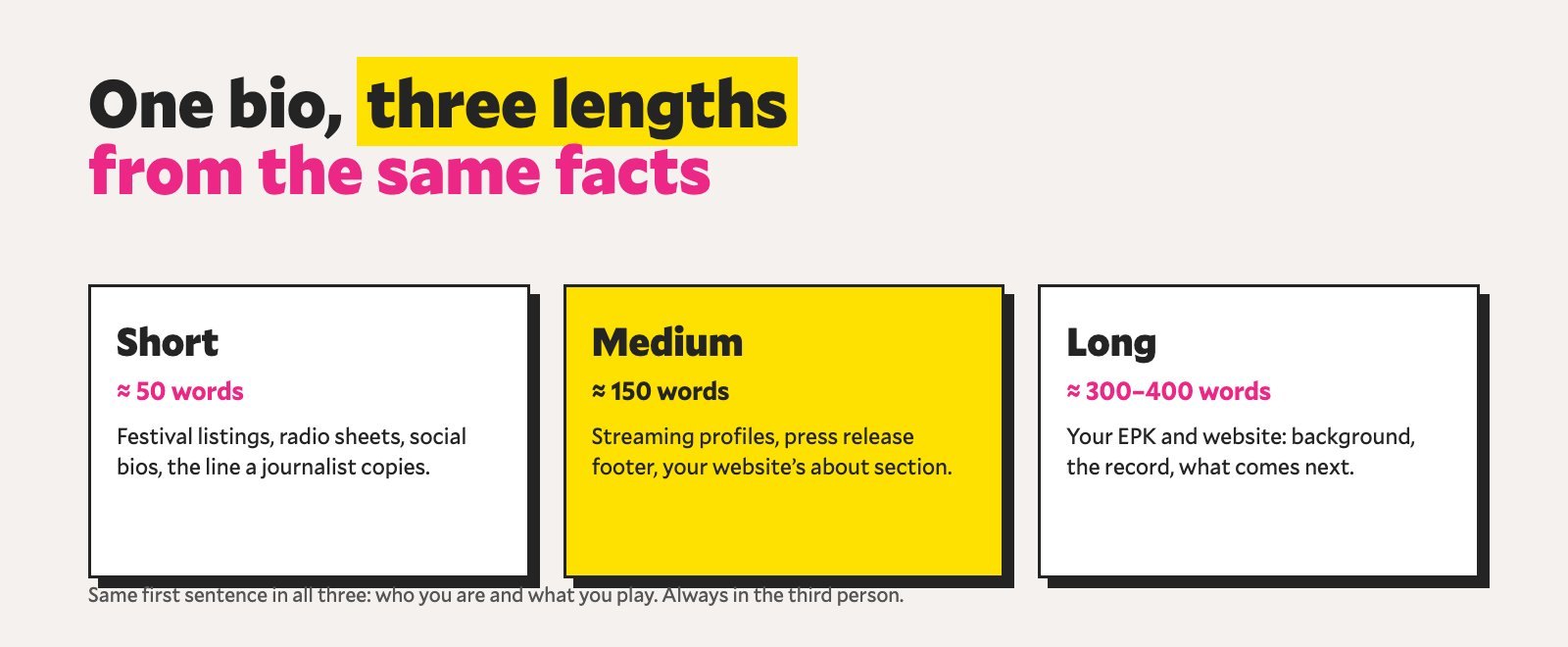
Keep three versions ready, written from the same facts:
| Version | Length | Where it goes |
|---|---|---|
| Short | 40–60 words | Concert listings, festival programmes, social media “about”, radio intros |
| Medium | 120–180 words | Streaming profiles, EPK top section, press releases |
| Long | 300–500 words | Full EPK, website “about” page, grant and festival applications |
Write the long one first if you have a lot of material, then cut. Or write the short one first if you struggle to say what matters: if it does not fit in 50 words, you have not decided yet.
How to write an artist bio, step by step
1. Open with who you are and what you play
Name, instrument or role, where you are based, genre in words a non-specialist understands. “Paris-based jazz pianist” is clearer than “sonic explorer”.
2. Say what your music sounds like, concretely
Instruments, influences, the scene you belong to, what is unusual about your line-up or repertoire. Use one or two references if they are honest, not to borrow fame. “Rooted in Venezuelan joropo and modern jazz harmony” tells the reader more than “eclectic and genre-defying”.
3. Lead with the current news
What are you releasing, touring or premiering now? Album title, label, date, key collaborators. This is the hook for a journalist: the news is what makes your bio relevant this month.
4. Add two or three real milestones
Notable venues, festivals, awards, collaborations, radio play, reviews. Pick the ones that matter to the reader you are writing for. A UK jazz promoter cares about Ronnie Scott’s more than a local talent prize; a classical festival cares about your ensemble and repertoire more than your streaming numbers.
5. Add one human detail
Where you grew up, how you came to the instrument, why this record exists. One detail, not your whole childhood. It is what makes a journalist want to ask a question.
6. End with what is next
Upcoming tour dates, the next release, where to hear you live. It tells the reader you are active.
7. Check every fact and name
Spell every musician, venue and label correctly. Use the same artist name and the same release title everywhere.
Musician bio examples (fictional)
These three examples describe an invented artist. Any resemblance to a real musician is a coincidence. They show the structure, not a formula: adapt the tone to your own music.
Short bio (fictional example, 54 words)
Marta Okafor is a London-based double bassist and composer whose quartet blends West African highlife rhythms with contemporary jazz. Her second album, Harbour Lights, comes out on 14 March on the independent label Northgate Records, with a launch concert at a small Soho jazz club the same week and UK dates through the spring.
Medium bio (fictional example, 137 words)
Marta Okafor is a London-based double bassist and composer. Raised between Lagos and Manchester, she grew up on her father’s highlife records before discovering jazz through the bass lines of Charles Mingus, and her music still moves between both worlds.
Her quartet, with Tom Reyes on trumpet, Ana Silva on piano and Kwame Mensah on drums, has played clubs and festivals across the UK since 2021. Her debut album, Second Tide, was played on national jazz radio and reviewed in the specialist press.
Her second album, Harbour Lights, comes out on 14 March 2027 on Northgate Records. Recorded live in two days, it features eight original compositions inspired by port cities she has lived in, from Lagos to Liverpool. The quartet launches the record in London in March, followed by a UK tour in April and May.
Long bio (fictional example)
A long bio takes the medium version and adds depth, not adjectives. The structure: who she is and the news, background, the band, the album, highlights, what is next.
Marta Okafor is a London-based double bassist and composer whose quartet brings the rhythms of West African highlife into contemporary jazz. Her second album, Harbour Lights, comes out on 14 March 2027 on Northgate Records.
Born in Lagos and raised in Manchester, Okafor grew up listening to her father’s highlife records: Victor Olaiya, Rex Lawson, the brass sections and the lilting guitars. She took up the electric bass at fourteen in a church band, switched to double bass at sixth-form college and went on to study jazz at a conservatoire in London. For several years she worked as a sidewoman in the city’s clubs, playing standards on weeknights and Afrobeat at weekends, until the two started to meet in her own writing.
Her quartet came together in 2021 with Tom Reyes on trumpet, Ana Silva on piano and Kwame Mensah on drums. The band’s sound rests on the bass and drums locking into highlife patterns while trumpet and piano improvise over modern jazz harmony. Their debut album, Second Tide, was played on national jazz radio and reviewed in the specialist press.
Harbour Lights was recorded live in two days, with the band in one room and no overdubs. Its eight original compositions are inspired by port cities Okafor has lived in or toured through, from Lagos to Liverpool. “Apapa Morning” opens with a field recording from the Lagos docks; “Mersey Blues” is a slow ballad written the week her grandmother died. Ghanaian guitarist Kofi Asante joins the quartet on two tracks.
Okafor has played festivals and clubs across the UK and in the Netherlands, and leads bass workshops for teenagers in East London. The quartet launches Harbour Lights in London in March, followed by a UK tour in April and May and the first European dates in the autumn.
(Fictional example, 300 words. The highlife musicians named are real references a bassist might cite; the artist, band, label and album are invented.)
Notice what is missing in all three: no “unique”, no “journey”, no “passionate”, no follower counts. Every sentence carries a fact.
Artist bio mistakes we see often
- Writing in the first person. Fine for an Instagram caption, not for a bio journalists will paste.
- Starting at birth. “Born in 1994, Marta started piano at four…” Lead with what you do now, and bring the past in only where it explains the music.
- Clichés. “Unique sound”, “pushes the boundaries”, “sonic journey”, “defies categorisation”, “passionate about music”. Every artist uses them, so they say nothing.
- A list of every gig you ever played. Choose the three that matter to this reader.
- Inflated claims. “Critically acclaimed” with no critic quoted, “world-renowned” for a first album. Journalists notice.
- Outdated bios. The band line-up changed, the “upcoming” album came out two years ago.
- Different bios everywhere. Your website, streaming profiles and EPK should tell the same story with the same facts.
How to use AI for a first draft (and what to fix yourself)
ChatGPT, Claude, Gemini, Mistral and other AI assistants can help you get past the blank page. The mistake is asking them to “write a bio for a jazz bassist”: you get the clichés listed above. What works for us is making the AI interview you first, one question at a time, like a journalist preparing a profile:
“You are a music journalist writing my artist bio. Before you write anything, interview me. Ask one question at a time and wait for my answer before the next one. Ask about where I’m from, how I came to music, what my music sounds like in concrete terms, who plays with me, my current release, two or three real milestones, and what is coming next. When you have enough, write three versions in the third person: 50 words, 150 words and 400 words. Plain, journalistic tone. No adjectives like unique, passionate or groundbreaking. Use only what I told you and do not invent awards, venues, reviews or numbers.”
You can answer in writing or by voice. Most of these assistants have a voice mode, or you can record a voice memo, transcribe it and paste the text. Many musicians explain their music much better speaking than typing.
What we always fix by hand afterwards:
- Every fact. Names, dates, venues, labels, spellings. AI tends to fill gaps with things that sound plausible.
- Clichés that sneak back in. Search the draft for “journey”, “unique”, “boundaries” and “tapestry”.
- Rhythm. AI drafts often have every sentence the same length. Read it aloud and vary it.
- The human detail. Make sure the one story that makes you you survived the edit.
That said, if you can afford it, nothing beats someone who writes for a living: a music copywriter, a press agency, or a music journalist who takes commissions (who, for ethical reasons, usually won’t review that same record afterwards). AI gets you to that conversation with your story in order, or gives you a decent draft when the budget isn’t there.
Where your bio will be used
Once you have the three versions, put them to work:
- Your EPK and the “about” page of your website.
- Your streaming profiles and social media.
- Press releases and pitches during a campaign, as part of your music marketing plan.
- Festival, showcase and grant applications.
- Concert listings: send the short version to every venue that books you, so they do not write their own.
When to ask for help
If you are about to release a record with a press campaign, the bio is part of the work. At Monart we write and edit artist bios in English, French and Spanish as part of our campaigns, for jazz, classical, world, folk, electronic and pop & rock artists. You can see some of the artists we have worked with, such as León Chiprout, Alon Farber or Grégory Sallet, on our Our Work page.
Want feedback on your bio? Book a one-hour video call with Gustavo Mezo to go through your bio and EPK together, with concrete notes on what to change. It costs €80, and the fee is deducted if you then hire Monart for a campaign. Book a consultation
FAQ
Should an artist bio be in the first or third person?
Third person. Journalists, promoters and festivals paste bios directly into their articles and programmes, and Apple Music for Artists also recommends writing the EPK bio in the third person.
How long should a musician bio be?
Keep three versions: a short one of 40 to 60 words, a medium one of 120 to 180 words and a long one of 300 to 500 words. Use the length that fits where it will appear.
What should I put first in my artist bio?
Who you are, what you play and what your music sounds like, followed by your current news. Your childhood and early training can come later, if they explain the music.
Can I use AI to write my artist bio?
You can use it for a first draft, ideally by having it interview you first so every fact comes from you. Always check the facts, cut the clichés and rewrite it in your own voice. If you have the budget, a professional writer is still the better option.
How often should I update my bio?
With every release, line-up change or major milestone. At minimum, update the “current news” paragraph before each campaign.
Should my bio be the same everywhere?
The facts should be. Use the short version for listings and socials, the medium for streaming profiles and press, and the long one for your EPK and website.
Sources
Apple Music for Artists, Why an Electronic Press Kit matters, read on 24 October 2026. The examples in this article describe a fictional artist. Search data: SE Ranking, October 2026.
By Gustavo Mezo, founder of Monart, a music marketing agency based in Paris.